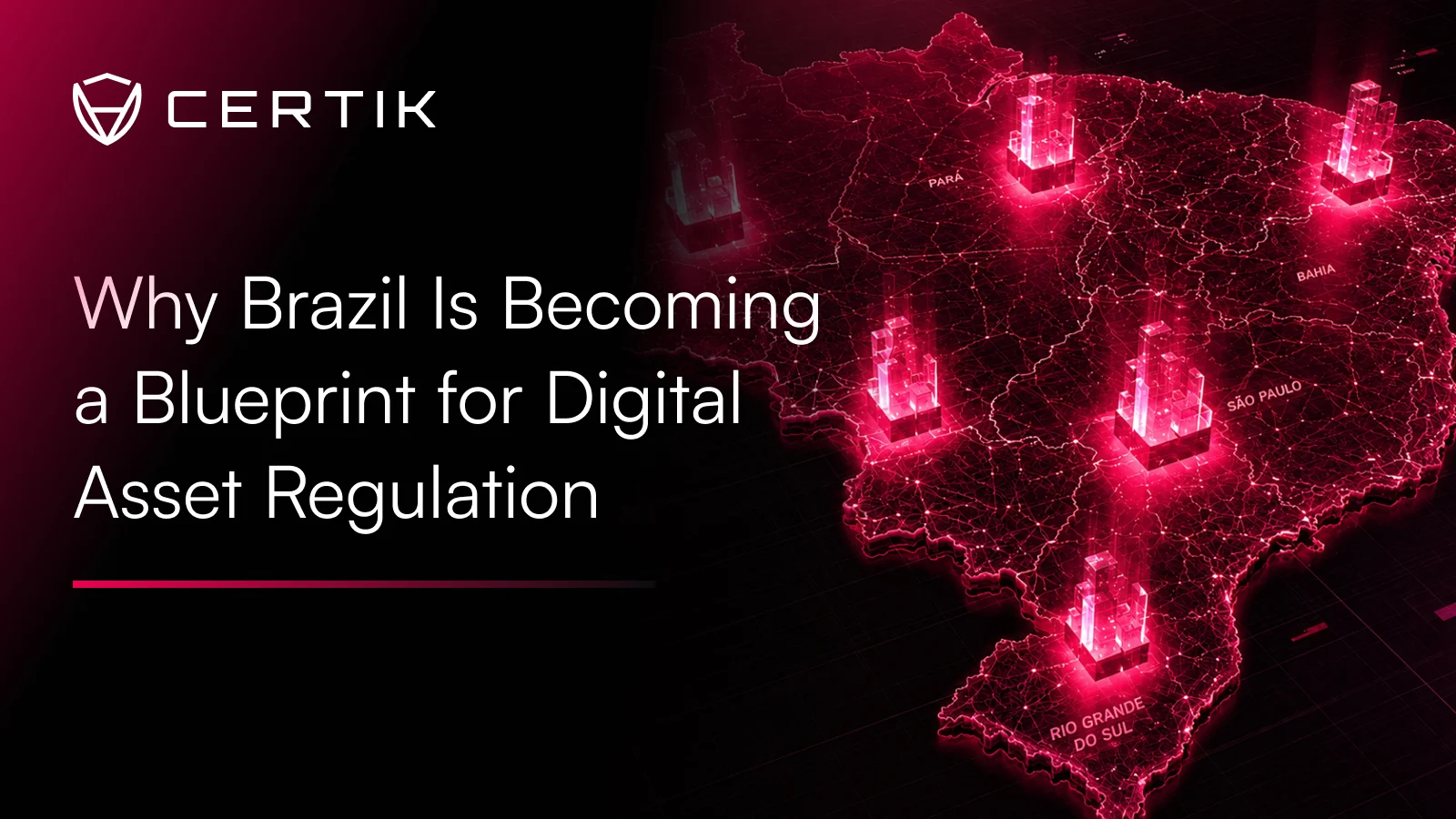
At this year's Blockchain.RIO, one theme cut across every panel CertiK took part in: Brazil's virtual asset regulation happening alongside market expansion.
Speaking in Rio de Janeiro on August 13, 2026, CertiK's Chief Business Officer Jason Jiang joined regulators, legal experts, and industry operators to unpack how far Brazil's Virtual Asset Service Provider (VASP) framework has come, and what that evolution means for companies preparing to enter one of the world's most closely watched digital asset markets.
From Warning Notices to a Fully Regulated Framework
It's easy to forget how recently Brazil's digital asset market was operating without dedicated rules. As Marcos Coelho da Rocha, Partner at Veirano Advogados, laid out during the panel, the regulatory story stretches back to 2014, when the Central Bank first defined digital assets. But the real inflection point came in 2024, when public consultations began shaping the parameters of the framework the market operates under today.
"In just three years, Brazil has moved from a broad legislative framework to detailed, operational, and comprehensive regulation," Rocha said. That pace is notable. Regulatory maturity that took other jurisdictions the better part of a decade has unfolded in Brazil in a fraction of the time. If anything, the most demanding requirements have arrived in just the last twelve months, given that the Central Bank has moved from broad principles to granular, operational rules.
The Market Asked for This
Perhaps the most striking point from the panel came from Nagel Paulino, Head of the Regulatory Division at the Central Bank of Brazil, who reframed the entire narrative around why the rules evolved so quickly. "We were able to advance these rules significantly because the market itself recognized that it needed to be regulated," Paulino said.
Regulation that's resisted by the industry it governs tends to move slowly and unevenly, with rules that don't map well to operational reality. Regulation that the market actively wants — because it recognizes that legitimacy, trust, and long-term growth depend on it — moves differently. Brazil's experience suggests that, when regulators and operators are aligned on the “why”, they can move fast on the “how.”
What Makes Brazil's Approach Different
Jiang provided more insights about where Brazil stands globally: "The Central Bank of Brazil is doing a great job because it is leading innovation and providing a high level of detail in its regulations for the Brazilian market."
Vague regulatory mandates leave companies guessing about what being compliant actually looks like, forcing them to either over-invest defensively or under-invest and hope for the best. Brazil's granular framework removes that guesswork. Companies know what capital thresholds apply, what controls need to be demonstrated, and what evidence regulators expect to see, all before they ever file an application. For global companies evaluating where to expand next, that clarity is itself a competitive advantage for the market.
Why Brazil, Specifically
Beyond the regulatory story, Jiang pointed to structural reasons why Brazil is a natural hub for digital asset adoption: the sheer size of its economy, a large population, and a significant share of Brazilians who remain outside the traditional banking system — exactly the population digital assets are best positioned to serve.
He also noted a data point worth sitting with: roughly 70% of major financial institutions already have some form of digital asset initiative underway. For Jiang, that's a strong signal that the convergence between traditional finance and blockchain infrastructure isn't a question of if, but when and how. "The final shape of this convergence has yet to be defined, but the trend toward the digitalization of financial assets is irreversible," he said.
What It Takes to Enter a Market Like This
During the fireside chat with Daniel Hott, Head of Legal and Compliance at Coins.xyz, Jiang laid out the criteria global companies weigh before entering a regulated market like Brazil:
- Compliance with local regulations — not just awareness of the rules, but demonstrable, evidence-backed alignment with them.
- Technological infrastructure capable of actually supporting regulated operations at scale.
- On-chain monitoring solutions to detect and respond to risk in real time.
- Incident response procedures that hold up under regulatory and market scrutiny alike.
Alongside these, Jiang emphasized one more factor that ties everything together: consumer trust. Meeting technical requirements is necessary, but it's the combination of compliance, infrastructure, and demonstrated trustworthiness that determines whether a market entry actually succeeds.
Hott offered a look at what that looks like in practice, describing Coins.xyz's own progress through the Central Bank's licensing process: "We are focused on ensuring the quality of our documentation, preparing in every possible way, and combining efforts to obtain the license as soon as possible so that we are ready for this new phase of regulation by the Central Bank."
The Bigger Picture
Brazil's trajectory offers a useful case study for the industry more broadly: regulatory clarity, arrived at through genuine dialogue between regulators and market participants, accelerates the kind of growth that lasts. As more jurisdictions work out their own approaches to digital asset oversight, Brazil's blend of speed, detail, and collaboration is one worth watching closely.
CertiK remains committed to supporting that evolution, working alongside regulators, operators, and market participants to help build the security and compliance infrastructure this next phase of adoption will run on.
FAQs
What is a VASP in Brazil?
A VASP (Virtual Asset Service Provider) is a company authorized by the Central Bank of Brazil to offer digital asset services such as custody, exchange, or brokerage. Brazil's regulatory framework requires VASPs to formally incorporate as regulated entities and meet specific capital, governance, and compliance standards.
Why is Brazil's crypto regulation considered fast-moving?
Brazil moved from its first legal definition of digital assets in 2014 to a fully detailed, operational VASP framework in roughly a decade with the most significant, granular requirements introduced in just the last few years. According to Veirano Advogados' Marcos Coelho da Rocha, the shift from broad legislation to comprehensive, operational rules happened in about three years.
Why did the Brazilian crypto market support stricter regulation?
According to Nagel Paulino, Head of the Regulatory Division at the Central Bank of Brazil, the market itself recognized the need for regulation, which allowed rules to advance quickly with less resistance than in jurisdictions where regulation is imposed without industry input.
What does CertiK do in the Brazilian digital asset market?
CertiK provides Web3 security services — including penetration testing, smart contract audits, and on-chain monitoring — that help VASPs meet the technical and evidentiary requirements of Brazil's Central Bank authorization process.
What criteria do global companies consider before entering a regulated market like Brazil?
Per CertiK CBO Jason Jiang, companies typically evaluate four factors: compliance with local regulations, technological infrastructure capable of supporting regulated operations, on-chain monitoring capabilities, and incident response procedures alongside building overall consumer trust.
Why is Brazil considered a strong market for digital asset adoption?
Brazil combines a large economy, a sizable population, and a significant portion of residents outside the traditional banking system, which are conditions well suited to digital asset adoption. Additionally, an estimated 70% of major financial institutions already have some form of digital asset initiative underway, signaling accelerating convergence between traditional finance and blockchain infrastructure.