Products & Technology
Featured Ecosystems


Company
CertiK Espresso at Korea Blockchain Week: Stablecoins, Compliance, and Security in the Spotlight


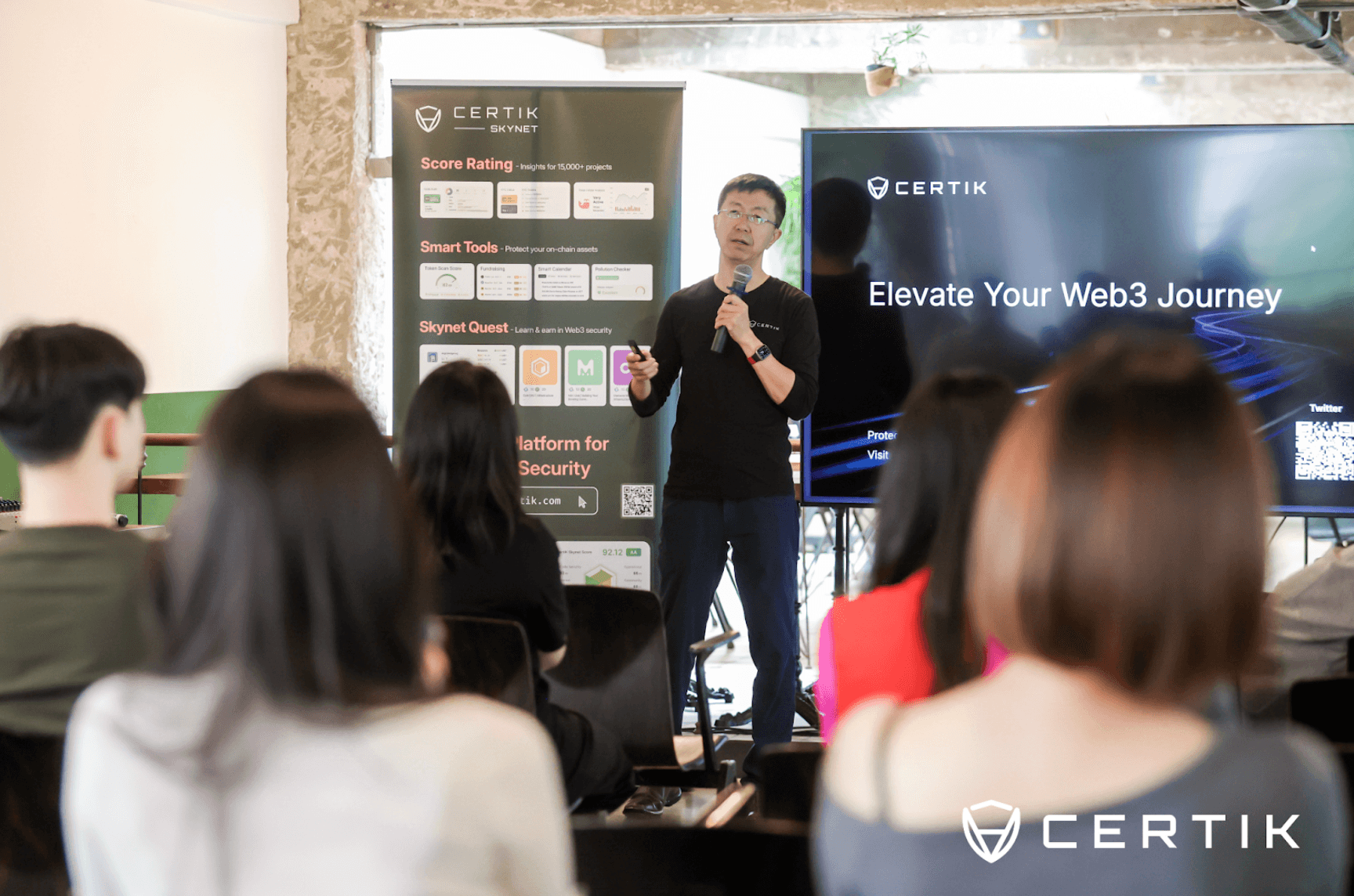
During this year’s Korea Blockchain Week (KBW), CertiK, the world’s largest Web3 security services provider, hosted “CertiK Espresso @KBW – Compliance Insights Workshop,” a gathering that brought together industry experts, executives, and investors from Korea and abroad. The workshop focused on stablecoins, regulatory frameworks, and the future of Web3, offering in-depth discussions on how compliance and security intersect with innovation.
Breaking Down Stablecoin Compliance Logic: Formal Verification Emerges as a Breakthrough
The workshop opened with a keynote speech by Dr. Kang Li, CertiK’s Chief Technology Officer, titled, “Pioneering a Secure Web3 Future.” Dr. Li reviewed CertiK’s experience in providing security solutions across the entire Web3 lifecycle, highlighting the company’s progress in auditing stablecoins. He stressed that compliance and security are not afterthoughts, but fundamental pillars that support projects from inception to maturity.
Dr. Li outlined the compliance pathway for stablecoin issuance, which he described as a three-step journey: business design, foundational infrastructure, and license acquisition. Once launched, stablecoins face risk management challenges across three dimensions: blockchain risks, asset risks, and operational risks. CertiK has developed tailored technical solutions for each category.
In addressing asset risk, Dr. Li emphasized four key factors: proof of reserves, transparency, standardization, and audit frequency. He explained that CertiK helps stablecoin issuers conduct regular reserve audits and public disclosures to ensure proper backing of circulating supply. CertiK also supports projects in creating standardized asset management processes to prevent operational lapses that could undermine trust.

A central highlight of his talk was the role of formal verification in regulatory compliance. Unlike traditional compliance reviews, which often rely on manual assessments, formal verification uses mathematical logic to prove whether a stablecoin system meets regulatory requirements such as those outlined in the U.S. GENIUS Act. Dr. Li described this level of “mathematical rigor” as increasingly valued by regulators.
Using the Ethereum Virtual Machine (EVM) ecosystem as an example, Dr. Li detailed CertiK’s verification process. First, regulatory requirements are translated into measurable security objectives, such as balance integrity, access controls, and emergency pause mechanisms. These are then broken down into specific security properties and codified into formal specifications. Finally, CertiK’s in-house Prover tool conducts automated verification: if the properties hold in all scenarios, compliance is mathematically proven; if not, the system generates counterexamples for remediation.
Local Perspectives Meet Global Insights: Addressing Security Pain Points Across Sectors

The fireside chat featured Hyeonsu Jin, an attorney from Decent Law Firm, who provided a localized perspective on Korea’s regulatory landscape. “Over the past year, Korea’s approach to Web3 has shifted from uncertainty to implementation, particularly with securities tokens now explicitly tied to the Capital Markets Act,” Jin noted. “This marks the beginning of an enforcement phase, requiring businesses to adapt to a more structured regulatory environment.” He highlighted “differentiated regulatory burdens” as a core challenge for Korean firms.
Exchanges, foundations, and Web3 gaming companies face vastly different regulatory requirements, forcing businesses to define their identities and navigate gaps between regulatory expectations and practical enforcement. Looking ahead, he predicted that Korea’s Web3 regulations will become more detailed within the next two to three years, with stablecoin-specific rules likely to emerge, alongside sectoral frameworks for exchanges, DeFi protocols, and gaming platforms. “Establishing local subsidiaries will become increasingly critical, as offshore structures give way to onshore entities—boosting transparency and strengthening trust,” he added.

The subsequent panel discussion further broadened the scope of dialogue. CertiK brought together KAIA, United Games, GSR.IO, Ava Labs, ChainGPT, and BISONAI to explore key themes, including next-generation Web3 gaming, DeFi, RWA, and the convergence of AI and blockchain. Speakers drew on their business practices and industry insights to confront existing challenges while also offering perspectives on future trends.
On the Web3 gaming front, a representative from United Games criticized the industry’s overreliance on token-driven economies, which has shortened game lifecycles. KAIA emphasized lowering entry barriers and enabling cross-game asset interoperability as ways to boost user retention, while noting that cross-chain security must remain a prerequisite. Turning to DeFi and AI integration, an Ava Labs representative highlighted the use of AI for sentiment analysis and strategy execution, cautioning against the risks of “black-box” algorithms. GSR.IO added that institutional players are increasingly focused on data auditability, recommending that key elements of AI decision-making logic be recorded on-chain. Regarding RWA, GSR.IO argued that retail adoption still faces significant hurdles in licensing and custody, while Ava Labs pointed to local pilots such as a KRW-backed stablecoin, stressing that the true value of RWA lies in unlocking asset liquidity rather than simply scaling tokenization.
Throughout the discussion, security emerged as the common thread. Whether in cross-game asset flows, AI-powered trading, or RWA custody, participants agreed that innovation cannot come at the expense of security. This balance between innovation and protection was underscored as a defining challenge for Korea’s Web3 industry as it moves toward maturity.
WEMIX CEO’s Keynote: Compliance and Community as the Cornerstones of Korea’s Web3 Market

Following the panel discussion, Shane Kim, CEO of the WEMIX Foundation, delivered a keynote titled “Korean Compliance: Community Matters.” He highlighted the unique characteristics of the Korean Web3 market, noting factors such as a single language and shared cultural identity, a highly educated and competitive society, and an environment that allows rapid information dissemination. According to Kim, these attributes have shaped a highly analytical and tech-savvy user base with strong technology adoption.
Kim also emphasized Korea’s vibrant online community culture. From restaurant reviews to news sources, information in Korea is widely shared through online communities, which in turn can influence public opinion and policy-making. In the Web3 space, where clear legal frameworks are often lacking, he noted that community concerns frequently trigger investigations or regulatory actions.
Drawing on his experience managing WEMIX, Kim explained that community feedback is a key input when launching new services or developing operational strategies, and it is closely integrated with compliance and product design. He stressed, “For global Web3 companies entering the Korean market, the community cannot be overlooked. Success depends on carefully observing and understanding the community.”
From Expert Panels to Casual Networking: CertiK Builds Long-Term Local Ties

As Web3 globalization and localization advance in parallel, compliance and security have become prerequisites for sustainable growth. CertiK Espresso demonstrated the value of bridging global perspectives with local realities, underscoring the role of security providers in ecosystem building.
From deep collaborations with domestic leaders like WEMIX and KAIA, to expanding its Korea regional branch and recruiting local talent, CertiK continues to pursue a dual strategy of localization and specialization. The company delivers world-class security services tailored to Korean projects while leveraging homegrown expertise to align with market-specific needs.

CertiK will continue this momentum with “Meet CertiK @KBW – Brunch Cafe” on September 24, an informal networking session designed to facilitate deeper conversations between CertiK’s team and Korea’s Web3 community. This shift from formal panels to casual engagement reflects CertiK’s long-term commitment to resonating with the Korean market—not merely as an external service provider, but as an active participant in ecosystem growth.
Looking ahead, CertiK’s strengthened presence in Korea is set to deliver more tailored security solutions while offering the global Web3 community a living case study of how compliance and security can advance hand in hand.