
Download the full report here!
The Digital Asset Treasury (DAT) model has matured from a niche corporate strategy into a popular and growing market, with public companies now holding over $130 billion in digital assets. This model, which defines a class of public companies accumulating digital assets as a primary balance sheet strategy, has successfully created a regulated, high-beta vehicle for traditional finance (TradFi) investors to gain exposure to the crypto ecosystem.
However, the landscape is undergoing a fundamental shift. The initial novelty premium that rewarded early adopters is eroding under the weight of increased competition, the availability of spot ETFs, and intensifying regulatory scrutiny. Joint investigations by the SEC and FINRA into pre-announcement trading activity, coupled with landmark legislation like the EU's Markets in Crypto-Assets (MiCA) and the upcoming U.S. CLARITY Act, are establishing clearer and stricter rules for the industry. In this environment, a DAT company's valuation is no longer driven solely by the size of its holdings.
This report introduces the Skynet DAT Security & Compliance Framework, a model that moves beyond surface-level metrics to provide an assessment of a DAT's operational integrity. By analyzing five critical pillars: Custodian & Third-Party Diligence, Internal Controls & Operational Security, On-Chain Risk Exposure, Capital Strategy Resilience, and Regulatory & Disclosure Posture, the framework reveals significant disparities in the quality and resilience of leading firms.
Key Takeaways:
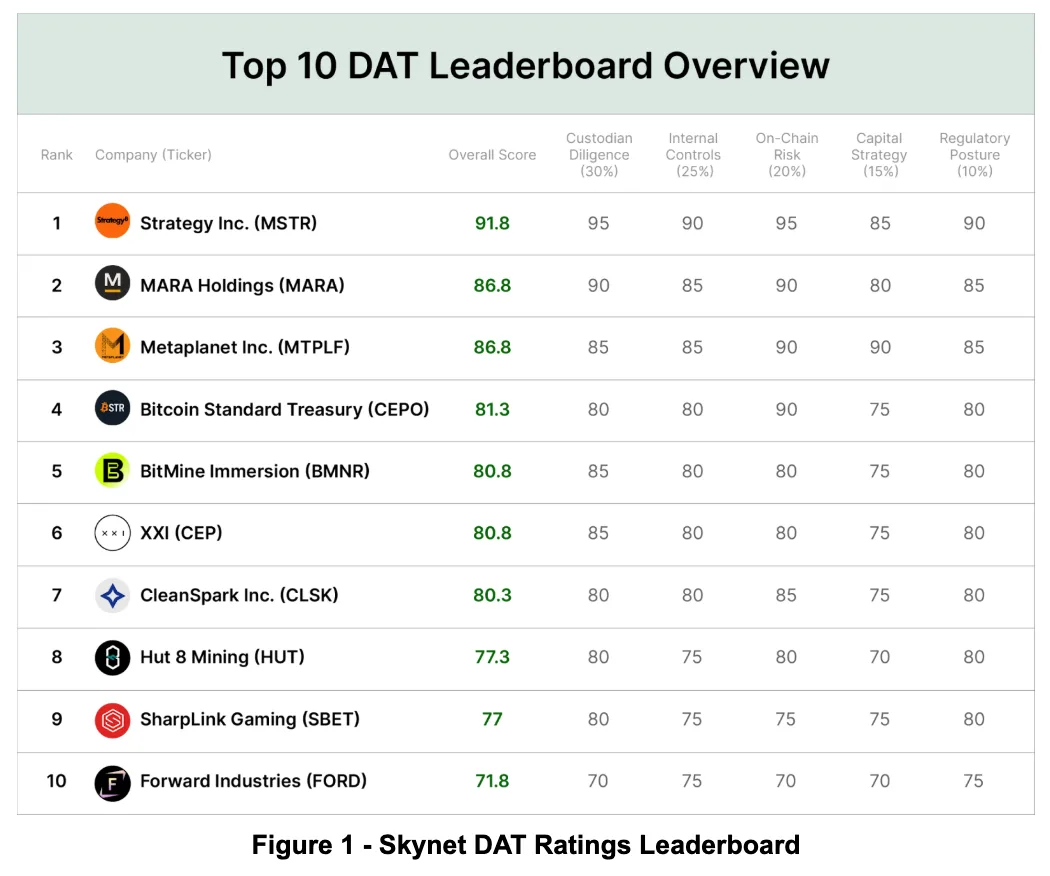
Strategy Inc. (MSTR) is the definitive leader with the report's highest Skynet Score of 91.8, setting the industry benchmark for security and compliance. The firm's top ranking is driven by its use of regulated custodians with multi-sig security, robust internal controls validated by annual SOC 2 audits, and a transparent, fully compliant disclosure posture with the SEC.
Intensifying global regulatory scrutiny is establishing stricter rules for the industry, favoring well-capitalized firms with proactive compliance infrastructures. Joint SEC/FINRA investigations and new legislation like the EU's MiCA are creating a clear divide, making robust compliance a prerequisite for long-term resilience and investor confidence.
The choice of a regulated, institutional-grade custodian is the single most critical factor for a high Skynet score, a trait shared by all top-performing DATs. With "Custodian & Third-Party Diligence" being the framework's most heavily weighted pillar (30%), the use of audited and insured partners like Coinbase Custody and Fidelity Digital Assets is a foundational element for a leading DAT.
Major Non-BTC treasuries are penalized in their scores for on-chain risk, highlighting the framework's focus on asset safety over yield generation. Firms SharpLink Gaming, which stake a majority of their assets, have their scores lowered due to increased vulnerability to smart contract exploits and network risks.
The DAT market has matured beyond rewarding novelty, with long-term valuation now impacted by operational integrity. The erosion of the initial "novelty premium" means that disciplined treasury management, sophisticated risk mitigation, and a strong security posture are the key differentiators for success.
The Digital Asset Treasury Model
A Digital Asset Treasury (DAT) is a publicly listed firm whose core strategy is to hold cryptocurrencies like Bitcoin (BTC) or Ethereum (ETH) on its balance sheet. This model offers a regulated, equity-based instrument for institutional and retail investors to gain exposure to digital assets without the complexities of direct custody. Investors often treat DAT shares as leveraged proxies for the underlying asset, with stock performance influenced by financing strategies and the ability to increase the amount of digital assets per share.
The model has evolved significantly since its inception:
- Asset Diversification: While pioneered with a Bitcoin-only focus, the landscape now includes major ETH-focused treasuries (BitMine Immersion, SharpLink Gaming) and a growing number of firms concentrating on other coins like Solana (Forward Industries).
- Hybrid Models: A new trend sees operating companies in sectors like genomics (Prenetics) and biotech (Predictive Oncology) adopting DAT strategies. These "hybrid models" use free cash flow from core operations to fund digital asset purchases, creating a more sustainable accumulation model that is less reliant on volatile capital markets. However, this approach can create valuation complexity as investors must assess two disparate business models.
Capital Formation and Associated Risks
A DAT's growth depends on its ability to raise capital efficiently. The two primary methods reveal much about a company's market position and risk profile.
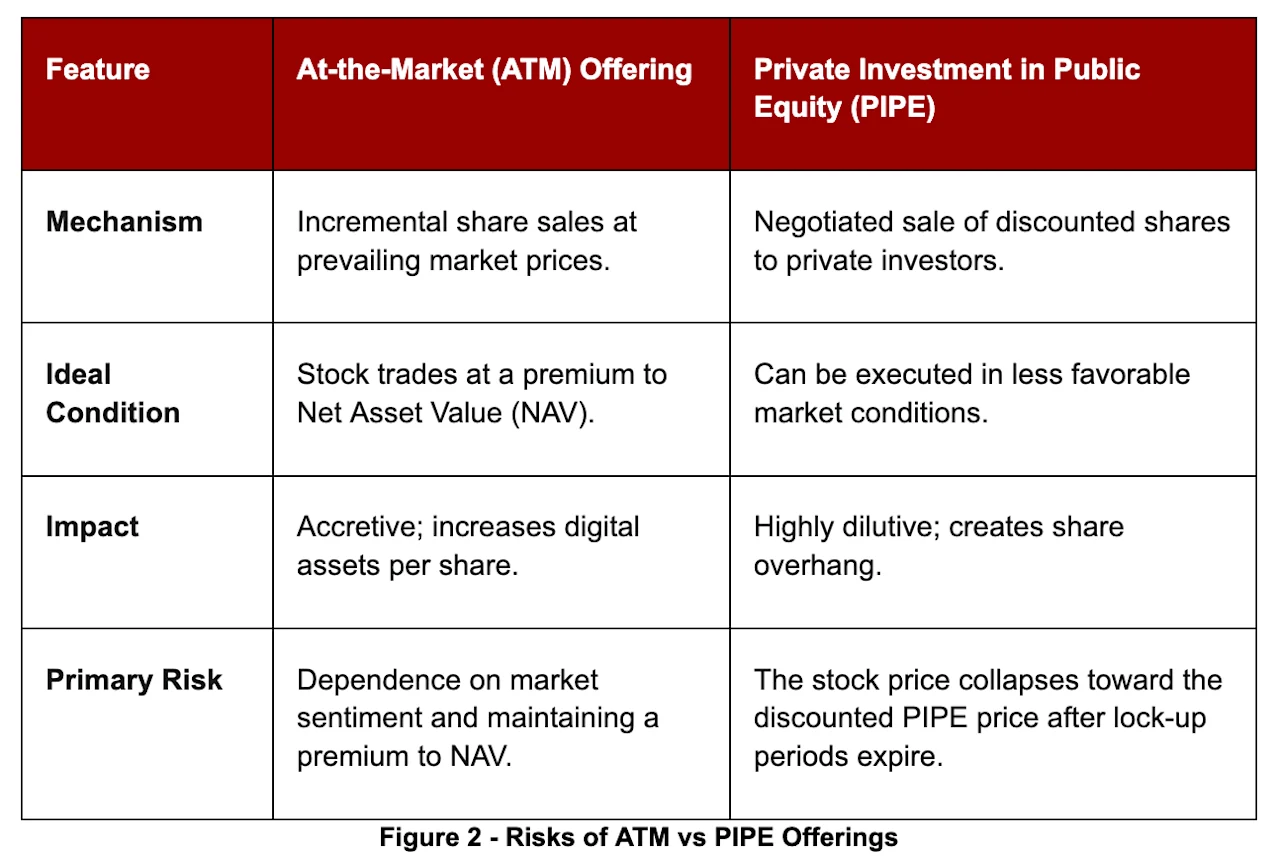
The risk of "PIPE price gravity" is not theoretical. Companies like Kindly MD (NAKA) have seen their stock price collapse by as much as 97% after a PIPE lock-up expired, effectively erasing the gains of public market investors. This dynamic makes a DAT's reliance on PIPE financing a significant red flag, often signaling a weaker market position compared to firms that can consistently execute accretive ATM offerings.
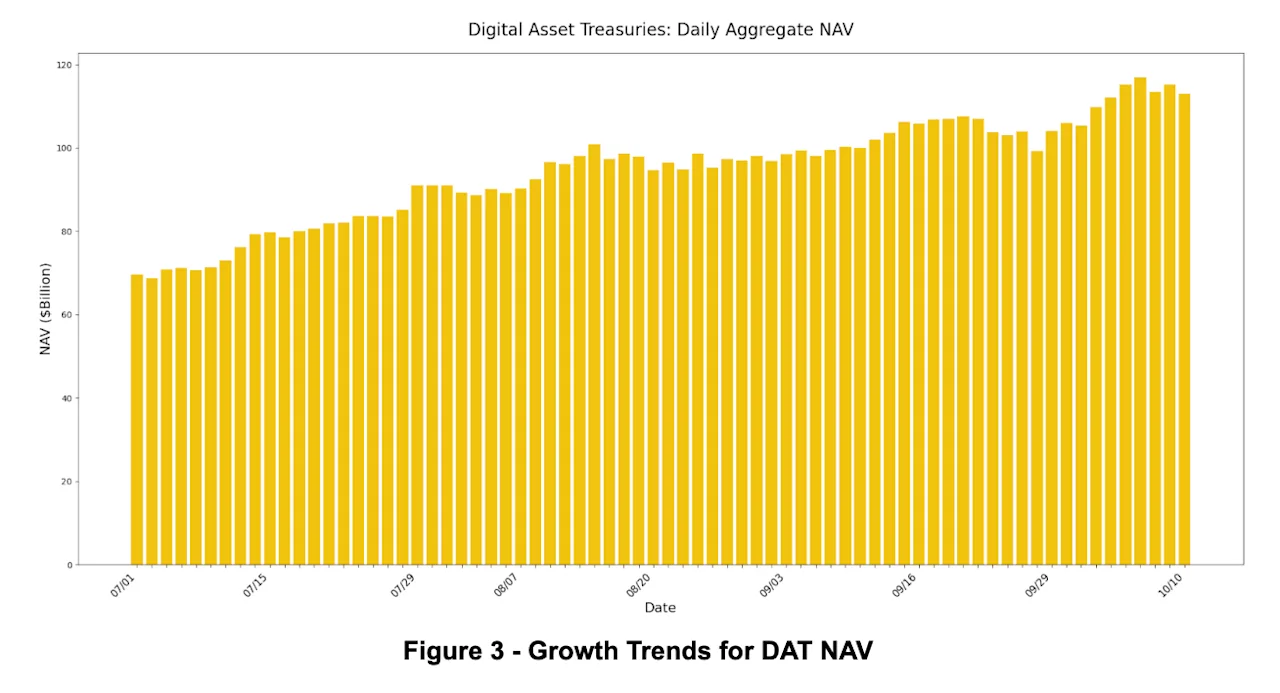
Despite these instances, the daily aggregated net asset value (NAV) has grown steadily over the past few months as different entrants continue to enter the market with unique strategies.
The Evolving Regulatory Landscape
DATs operate at the complex intersection of securities law and digital assets, and the regulatory environment is rapidly solidifying.
- Insider Trading and Disclosure: U.S. regulators are actively enforcing existing securities laws. A joint SEC and FINRA probe is examining unusual trading volumes and price spikes in over 200 companies that occurred just before they announced new crypto treasury strategies. This signals a crackdown on potential violations of Rule 10b-5 (Insider Trading) and Regulation FD (Fair Disclosure), which prohibits selective disclosure of material non-public information.
- U.S. Legislative Frameworks: The proposed Digital Asset Market Clarity Act of 2025 (CLARITY Act) aims to divide regulatory authority between the SEC and the CFTC by defining categories such as "digital commodities." Concurrently, the GENIUS Act, signed in July 2025, establishes a federal framework for payment stablecoins, mandating full-reserve backing, audits, and AML controls.
- International Standards: In Europe, the Markets in Crypto-Assets (MiCA) regulation is now being implemented, creating a unified legal framework for crypto-asset service providers (CASPs) across the EU. Globally, the Financial Action Task Force (FATF) "Travel Rule" continues to impose AML/CFT obligations, requiring VASPs to collect and share sender and recipient information for crypto transfers.
This global trend toward greater regulatory certainty will favor larger, well-capitalized DATs with robust compliance infrastructures.
The Skynet DAT Security & Compliance Framework
The Skynet Framework provides a quantitative score for each DAT, assessing operational integrity across five weighted pillars.
- Pillar 1: Custodian & Third-Party Diligence (30%): Evaluates the quality, regulation, and diversification of custodians. High scores are awarded for using multiple, regulated custodians (e.g., NYDFS-chartered trust companies) with independent SOC audits and transparent insurance coverage.
- Pillar 2: Internal Controls & OpSec (25%): Assesses treasury governance, insider threat mitigation, and security best practices. This includes the use of multi-signature (multisig) or Multi-Party Computation (MPC) wallets, formal board-approved policies for transactions, and regular third-party security audits.
- Pillar 3: On-Chain Risk Exposure (20%): Quantifies risks from active on-chain strategies. Higher scores are given for holding established assets like BTC and ETH. Exposure to staking (slashing risk) or DeFi (smart contract risk) lowers the score. Proactive on-chain monitoring for AML compliance is also a key metric.
- Pillar 4: Capital Strategy Resilience (15%): Measures the sustainability of a DAT's financing model. High scores are awarded for the demonstrated ability to use accretive ATM offerings, while reliance on dilutive PIPEs and excessive leverage negatively impact the score.
- Pillar 5: Regulatory & Disclosure Posture (10%): Assesses the timeliness and granularity of public filings and the company's history with regulators. A proactive and transparent approach to compliance earns a higher score.
Skynet DAT Leaderboard and Showcase
This section applies the Skynet Framework to rank leading DATs within the Top 3 crypto assets (BTC, ETH, SOL) by their overall score, providing a standardized comparison of their strategies, security, and compliance postures.
Top 10 DAT Leaderboard Overview
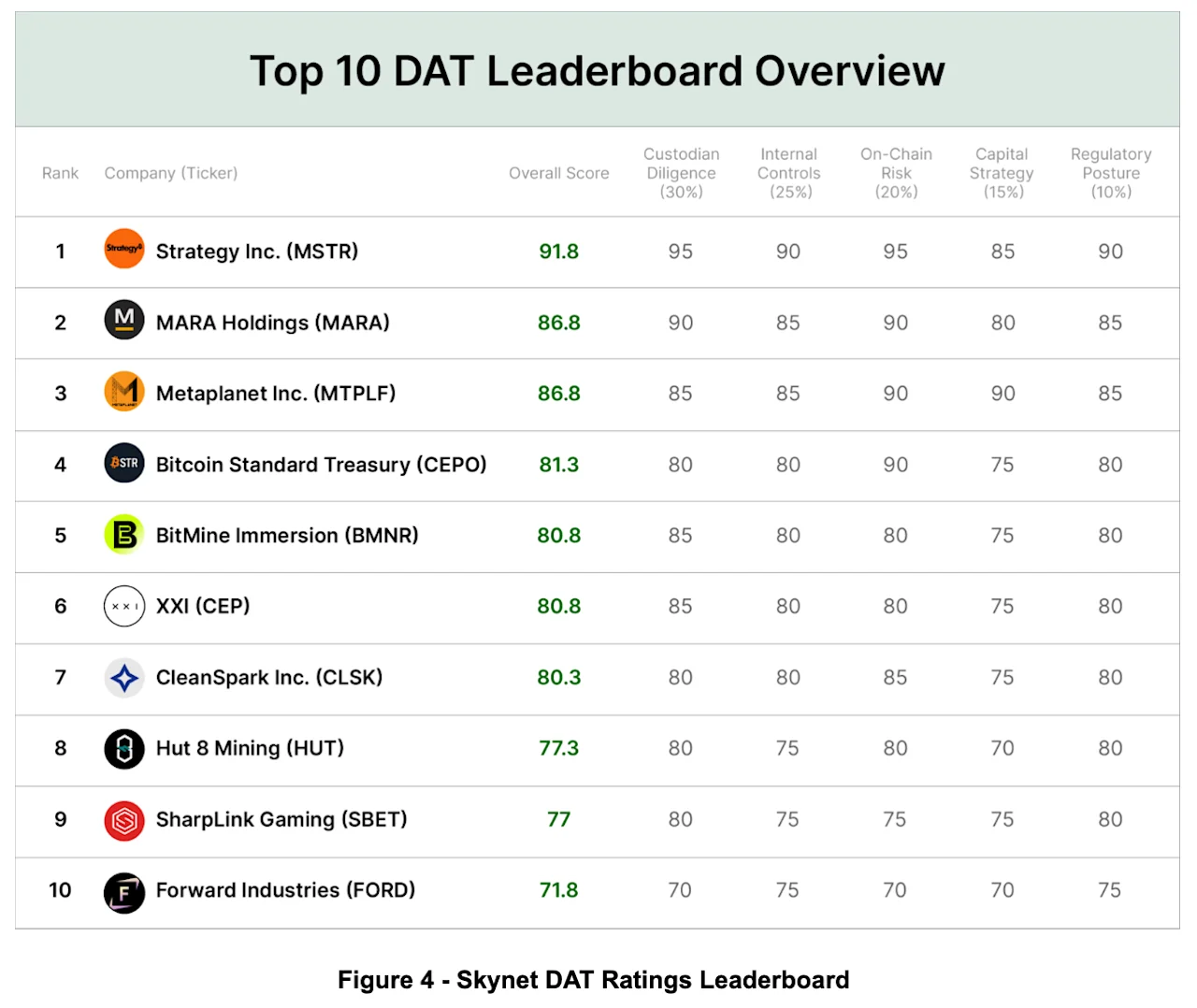
Company Showcase
Strategy Inc. (MSTR)
- Rank: #1
- Primary Asset: BTC
- Holdings Value: ~114K/BTC)
- Skynet Rating: 91.8
- Key Analytics: Strategy Inc. remains the world’s leading corporate Bitcoin treasury, treating BTC as a strategic reserve asset to hedge against inflation and currency depreciation. According to SEC filings, the company uses qualified custodians, including Coinbase Custody, to safeguard its assets. While Strategy maintains robust institutional-grade security and compliance measures, it does not publicly disclose wallet addresses or detailed multi-signature arrangements, citing security considerations.
- Custodian & Third-Party Diligence (30%): 95/100 - Relies on Coinbase Custody with multi-signature wallets and multi-party computation for enhanced security, backed by insurance and diversified backups to mitigate counterparty risks.
- Internal Controls & OpSec (25%): 90/100 - Implements robust internal controls including annual SOC 2 Type II audits and strict key management protocols, ensuring operational security against insider threats.
- On-Chain Risk Exposure (20%): 95/100 - Minimal exposure as holdings are primarily off-chain in cold storage, avoiding DeFi protocols and smart contract vulnerabilities.
- Capital Strategy Resilience (15%): 85/100 - Utilizes convertible debt and equity raises for acquisitions, demonstrating resilience through unrealized gains and diversified funding, though leverage introduces some volatility.
- Regulatory & Disclosure Posture (10%): 90/100 - Fully compliant with SEC requirements, providing transparent filings and adopting new accounting standards like ASU 2023-08 for fair value measurement.
MARA Holdings (MARA)
- Rank: #2
- Primary Asset: BTC
- Holdings Value: ~114K/BTC)
- Skynet Rating: 86.8
- Key Analytics: MARA integrates mining with treasury accumulation for long-term BTC exposure. Custody is handled by Fidelity Digital Assets. MARA provides detailed cold storage disclosures to enhance transparency and compliance.
- Custodian & Third-Party Diligence (30%): 90/100 - Uses Fidelity Digital Assets with insured custody and diversified infrastructure, reducing third-party exposure through established protocols.
- Internal Controls & OpSec (25%): 85/100 - Regular internal audits and cold storage emphasis, bolstering OpSec against operational threats
- On-Chain Risk Exposure (20%): 90/100 - Low on-chain risks as focus is on mining and holding, with minimal DeFi involvement.
- Capital Strategy Resilience (15%): 80/100 - Self-mining reduces costs and enhances resilience to halvings, supported by equity raises for expansion.
- Regulatory & Disclosure Posture (10%): 85/100 - Strong Nasdaq and SEC compliance with monthly production disclosures and financial reporting.
Metaplanet Inc. (MTPLF)
- Rank: #3
- Primary Asset: BTC
- Holdings Value: ~$3.51B (30,823 BTC)
- Skynet Rating: 86.8
- Key Analytics: Metaplanet is aggressively expanding its BTC holdings as a hedge against yen depreciation. Custody is managed by SBI VC Trade. The firm has surpassed its target of 30,000 BTC (currently at 30,823 BTC), supported by yen-based loan financing. Security measures include internal protocols for treasury management, though multi-factor authentication is unconfirmed in regulatory filings.
- Custodian & Third-Party Diligence (30%): 85/100 - Uses SBI VC Trade for custody, with expansions into U.S. subsidiaries for diversified operations.
- Internal Controls & OpSec (25%): 85/100 - Implements internal protocols for treasury management, as per filings.
- On-Chain Risk Exposure (20%): 90/100 - Primarily holding with low on-chain activity, though derivatives expansion adds minor risks.
- Capital Strategy Resilience (15%): 90/100 - Yen loans and share offerings provide resilient hedging against fiat weakness.
- Regulatory & Disclosure Posture (10%): 85/100 - Tokyo Stock Exchange compliant with detailed filings on acquisitions and strategies.
Bitcoin Standard Treasury Company (BSTR)
- Rank: #4
- Primary Asset: BTC
- Holdings Value: ~$3.42B (30,021 BTC)
- Skynet Rating: 81.3
- Key Analytics: BSTR is dedicated to pure BTC treasury accumulation, positioning itself as a benchmark reserve holder. Custody is planned to be on-chain with real-time proof-of-reserves (no specific institutional provider like BitGo confirmed). BSTR serves as a balanced alternative to mining-focused peers. Compliance is maintained through regular filings and audits, ensuring institutional-grade transparency.
- Custodian & Third-Party Diligence (30%): 80/100 - the company has indicated that post-listing it will custody all Bitcoin transparently on-chain with real-time proof-of-reserves
- Internal Controls & OpSec (25%): 80/100 - Focuses on audits and risk mitigation for Bitcoin holdings, addressing custody and compliance internally.
- On-Chain Risk Exposure (20%): 90/100 - BSTR has stated it will custody its Bitcoin with transparent on-chain proof-of-reserves (publishing addresses in real time).
- Capital Strategy Resilience (15%): 75/100 - BSTR’s capital strategy is exemplified by its rapid accumulation of Bitcoin via a SPAC merger and a diversified financing structure designed to minimize immediate dilution.
- Regulatory & Disclosure Posture (10%): 80/100 - BSTR has already committed to an unusually transparent practice of publishing real-time on-chain proof-of-reserves for its Bitcoin.
BitMine Immersion Technologies (BMNR)
- Rank: #5
- Primary Asset: ETH
- Holdings Value: ~4,100/ETH)
- Skynet Rating: 80.8
- Key Analytics: BMNR leads in ETH treasuries, planning to stake portions of its holdings for yield while leveraging immersion technology for mining efficiency. Assets are custodied by BitGo and Fidelity Digital Assets. With holdings now above 3.31M ETH. Security is supported by audits and SEC filings, though planned staking could expose the firm to smart contract risks.
- Custodian & Third-Party Diligence (30%): 85/100 - Employs BitGo and Fidelity Digital Assets for custody with third-party insurance implied, reducing risks through diversified custodians, though primarily US-based operations.
- Internal Controls & OpSec (25%): 80/100 - Conducts audits and maintains internal governance reforms, focusing on operational security for mining activities (staking planned but not yet implemented)
- On-Chain Risk Exposure (20%): 80/100 - Low exposure as focus is on holding with minimal on-chain activity, though planned staking could add risks to smart contract exploits and Ethereum network vulnerabilities.
- Capital Strategy Resilience (15%): 75/100 - Relies on private placements and equity programs for growth, showing resilience in scaling but with dilution risks from ongoing fundraising.
- Regulatory & Disclosure Posture (10%): 80/100 - Compliant with NYSE American and SEC standards, with detailed filings on treasury strategy, but faces potential scrutiny over dilution and crypto holdings.
XXI (CEP)
- Rank: #6
- Primary Asset: BTC
- Holdings Value: ~$4.96B (43,514 BTC)
- Skynet Rating: 80.8
- Key Analytics: XXI follows a pure holding model, balancing operational efficiency with BTC treasury growth as a Bitcoin-native company. Custody is managed on-chain with real-time Proof of Reserves. For security, XXI provides transparent on-chain verifiability, reinforcing external confidence.
- Custodian & Third-Party Diligence (30%): 85/100 - Custodies Bitcoin transparently on-chain with real-time proof-of-reserves, likely incorporating multi-sig, though less diversified than top peers using multiple institutional custodians.
- Internal Controls & OpSec (25%): 80/100 -Employs internal protocols focused on Bitcoin-native operations, addressing security through on-chain transparency
- On-Chain Risk Exposure (20%): 80/100 - Moderate exposure limited to holding, with low DeFi ties.
- Capital Strategy Resilience (15%): 75/100 - Uses capital markets and SPAC structures for growth, resilient but with integration risks from mergers.
- Regulatory & Disclosure Posture (10%): 80/100 - Compliant with SEC via SPAC and filings, transparent on holdings but with an emerging posture.
CleanSpark Inc. (CLSK)
- Rank: #7
- Primary Asset: BTC
- Holdings Value: ~$1.48B (13,011BTC)
- Skynet Rating: 80.3
- Key Analytics: CLSK emphasizes sustainable mining and treasury growth, with assets collateralized through Coinbase Prime and Two Prime for credit facilities. Its ESG-focused disclosures highlight its commitment to green mining, while compliance filings and audits strengthen its transparency.
- Custodian & Third-Party Diligence (30%): 80/100 - Partners with Coinbase Prime and Two Prime for Bitcoin-backed credit, ensuring collateralized and diversified handling for pledged assets
- Internal Controls & OpSec (25%): 80/100 - Focuses on ESG audits and internal controls for sustainable operations, including collateral management.
- On-Chain Risk Exposure (20%): 85/100 - Balanced mining/holding with partial sales, low DeFi exposure.
- Capital Strategy Resilience (15%): 75/100 - Bitcoin-backed loans enhance resilience, but sensitivity to price volatility remains.
- Regulatory & Disclosure Posture (10%): 80/100 - Nasdaq compliant with monthly mining updates and SEC filings.
Hut 8 Mining (HUT)
- Rank: #8
- Primary Asset: BTC
- Holdings Value: ~$1.21B (10,677 BTC)
- Skynet Rating: 77.3
- Key Analytics: Hut 8 is a Canadian mining leader focused on efficient BTC accumulation. Assets are custodied by Coinbase Custody and BitGo Trust Company. Supported by compliance with Canadian regulatory standards and high transparency in disclosures.
- Custodian & Third-Party Diligence (30%): 80/100 - Uses Coinbase Custody and BitGo Trust Company for custody, with expansions in energy infrastructure for diversified operations.
- Internal Controls & OpSec (25%): 75/100 - Implements controls for mining and AI integration, with EBITDA-focused audits.
- On-Chain Risk Exposure (20%): 80/100 - Moderate from mining, but low DeFi; focuses on holding.
- Capital Strategy Resilience (15%): 70/100 - Energy assets and liquidity provide resilience, but profit-taking volatility affects it.
- Regulatory & Disclosure Posture (10%): 80/100 - Dual Nasdaq/TSX compliant with quarterly results and governance boosts.
SharpLink Gaming (SBET)
- Rank: #9
- Primary Asset: ETH
- Holdings Value: ~$3.52B (859,853 ETH)
- Skynet Rating: 77
- Key Analytics: SBET leverages ETH as a treasury asset, staking ~99-100% of holdings for yield. Custody is unconfirmed (likely self-custody with on-chain staking). The portfolio is supported by ties to Ethereum co-founder Joe Lubin and potential DeFi integrations like tokenization. Security is enhanced by SEC filings and internal controls, though reliance on ecosystem performance adds volatility.
- Custodian & Third-Party Diligence (30%): 80/100 - Custody unconfirmed (likely self-custody with on-chain staking), including tokenization partnerships for added diligence.
- Internal Controls & OpSec (25%): 75/100 - Internal controls supported by SEC filings, but the shift to an ETH treasury introduces new OpSec challenges (SOC audits unconfirmed).
- On-Chain Risk Exposure (20%): 75/100 - High due to ~99-100% staking and DeFi ties, exposing it to on-chain vulnerabilities.
- Capital Strategy Resilience (15%): 75/100 - Equity raises and staking rewards provide resilience, but volatility from the gaming pivot affects stability.
- Regulatory & Disclosure Posture (10%): 80/100 - Nasdaq compliant with SEC filings on the treasury shift, including staking rewards disclosures.
Forward Industries (FORD)
- Rank: #10
- Primary Asset: SOL
- Holdings Value: ~200/SOL)
- Skynet Rating: 71.8
- Key Analytics: FORD diversifies into Solana to capture growth in scalable blockchain ecosystems. Custody is self-managed through Solana validator infrastructure. The firm benefits from Solana's DeFi momentum, though volatility remains high. Limited disclosures compared to BTC/ETH peers heighten its overall risk profile.
- Custodian & Third-Party Diligence (30%): 70/100 - Self-managed custody through Solana validator infrastructure for SOL holdings, with private placement diligence, but less mature than BTC custodians.
- Internal Controls & OpSec (25%): 75/100 - Basic audits for the treasury shift, but limited details on OpSec for altcoin exposure.
- On-Chain Risk Exposure (20%): 70/100 - 70/100 - High due to Solana's DeFi focus and volatility, with staking risks.
- Capital Strategy Resilience (15%): 70/100 - Private placements and ATM equity provide capital, but there is a heavy reliance on volatile SOL.
- Regulatory & Disclosure Posture (10%): 75/100 - Nasdaq compliant with S-3 filings on its SOL strategy, but emerging risks are noted in disclosures.
Altcoin DAT Spotlight
This category represents the highest-risk, highest-reward asset segment of the DAT market. These companies are pursuing an ecosystem thesis, where their success is inextricably linked to the performance and adoption of a single, less mature blockchain network. This makes them highly speculative and narrative-driven investments, often backed by key players within their chosen ecosystem.
TON Strategy Co (TSC)
- Primary Asset: Toncoin (TON)
- Holdings Value: ~$558M
- Skynet Alt Rating: 90
- Key Analytics: In August 2025, Nasdaq-listed Verb Technology raised approximately $558 million in a PIPE offering to establish the first public TON treasury, rebranding as TON Strategy Co. The move will make it one of the largest TON holders worldwide, with notable backers including 10X Capital, Kingsway, and Blockchain.com. The leadership team, featuring the founder of Kingsway and the CEO of Blockchain.com, brings deep crypto-institutional expertise.
- Custodian & Third-Party Diligence (30%): 90/100 - Expected to partner with institutional custodians and employ multi-signature security.
- Internal Controls & OpSec (25%): 90/100 - Led by experienced executives, the company is expected to adopt enterprise-grade controls and audits.
- On-Chain Risk Exposure (20%): 90/100 - Plans to stake TON for yield but will avoid high-risk DeFi protocols.
- Capital Strategy Resilience (15%): 90/100 - Heavily capitalized with broad institutional support and structured entirely through equity.
- Regulatory & Disclosure Posture (10%): 90/100 - As a Nasdaq-listed entity, it provides public SEC reporting and forward-looking disclosures on its TON strategy.
Avalanche Treasury Co. (AVAT)
- Primary Asset: AVAX
- Holdings Value: ~$660M
- Skynet Alt Rating: 88
- Key Analytics: Launched via a ~$675 million SPAC merger, Avalanche Treasury Co. was created to be a public AVAX treasury. AVAT began with approximately $460 million of AVAX and secured a $200 million discounted token allocation from the Avalanche Foundation. Its advisory board includes Avalanche founder Emin Gün Sirer, signaling close ties to the core development team. The company plans to actively deploy capital to support the growth of the Avalanche ecosystem.
- Custodian & Third-Party Diligence (30%): 90/100 - Will leverage institutional custody partners with multi-signature security and insurance.
- Internal Controls & OpSec (25%): 90/100 - Backed by Wall Street veterans, the company is expected to institute rigorous audit and security standards.
- On-Chain Risk Exposure (20%): 80/100 - While the treasury is mostly passive AVAX, strategic investments in the network introduce some execution risk.
- Capital Strategy Resilience (15%): 90/100 - Large initial funding and support from the Avalanche Foundation mitigate capital risk.
- Regulatory & Disclosure Posture (10%): 90/100 - The SPAC process mandates SEC disclosures, with ongoing Nasdaq compliance expected.
SUI Group Holdings (SUIG)
- Primary Asset: SUI
- Holdings Value: ~$332M (101.8M SUI)
- Skynet Alt Rating: 85.5
- Key Analytics: In mid-2025, specialty finance firm Mill City Ventures raised $450 million to pivot into a Sui treasury strategy, rebranding as SUI Group Holdings. As the first Nasdaq-listed SUI treasury, SUIG holds over 100 million SUI and is staking nearly all of it for a ~2.2% yield. The company is the only public entity officially affiliated with the Sui Foundation, granting it priority access to token sales and ecosystem initiatives.
- Custodian & Third-Party Diligence (30%): 90/100 - Likely employs institutional custody providers with multi-signature security for its on-chain SUI.
- Internal Controls & OpSec (25%): 80/100 - As a Nasdaq-listed company, it adheres to corporate audit standards and board oversight.
- On-Chain Risk Exposure (20%): 80/100 - Nearly all SUI is staked, which introduces smart-contract and validator risk.
- Capital Strategy Resilience (15%): 90/100 - Well-capitalized via a $450 million equity raise with no leverage.
- Regulatory & Disclosure Posture (10%): 90/100 - Fully SEC-reporting with ongoing disclosures, and its unique tie to the Sui Foundation underscores its legitimacy.
DAT Key Custodian Spotlight
A thorough due diligence process for a Digital Asset Treasury (DAT) must extend beyond surface-level claims. This research provides a granular analysis of the key custodians servicing the DAT market, focusing on the technical, regulatory, and operational pillars that define their institutional-grade status.
Coinbase Custody (part of Coinbase Prime)
- Overview & Regulatory Status: Coinbase Custody operates as a fiduciary under New York State Banking Law through Coinbase Custody Trust Company, LLC, which holds a limited purpose trust charter from the NYDFS. While this charter remains a core part of its regulatory foundation, Coinbase began pursuing a national trust charter in 2025 to expand federal oversight under the OCC. The entity continues to operate under NYDFS supervision during this transition, reflecting Coinbase’s shift from state-level to dual state–federal regulation.
- Security Practices & Technology: - Custody Model: Employs a defense-in-depth strategy with the vast majority (over 98%) of client assets held in proprietary, air-gapped cold storage. This system never connects to any network. - Key Management: Keys are generated, stored, and managed entirely offline in Hardware Security Modules (HSMs) that have achieved FIPS 140-2 Level 2 or higher certification. These HSMs are geographically distributed in secure vaults across the US and Europe. They utilize a proprietary form of multi-signature technology for authorizing transactions, requiring coordinated action from multiple, independent employees. - Operational Security (OpSec): Coinbase enforces strict internal controls, including dual control protocols ("two-person rule"), robust background checks for all employees with access to sensitive systems, and video surveillance of all critical operations. Address whitelisting is mandatory for all institutional clients, ensuring funds can only be moved to pre-approved addresses.
- Audits & Certifications: Regularly undergoes SOC 1 Type II and SOC 2 Type II audits, which validate controls over financial reporting and security/availability, respectively. It also maintains ISO 27001 certification for information security management.
- Insurance Coverage: Coinbase maintains a comprehensive insurance program. It carries a commercial crime policy that covers theft from its hot and cold wallet systems. Importantly, this is part of a larger market-leading insurance program for its entire platform. For segregated client assets held in Coinbase Custody, the legal structure as a trust company provides additional protections, ensuring assets are not co-mingled with corporate funds and are protected from corporate creditors.
- Institutional Services: Integrated into the Coinbase Prime platform, it offers a seamless ecosystem for institutions. This includes access to an agency-only OTC trading desk, real-time reporting, and staking services for a wide range of assets like Ethereum (ETH) and Solana (SOL). Staking is performed from dedicated, segregated cold wallets, mitigating risks.
- Skynet Verdict: Coinbase Custody represents the crypto-native institutional standard. Its strength lies in its battle-tested security, broad asset support, and seamless integration with a comprehensive prime brokerage service, all under the umbrella of a regulated, public U.S. company.
Fidelity Digital Assets
- Overview & Regulatory Status: Fidelity Digital Assets is the cryptocurrency arm of Fidelity Investments, one of the world's largest financial services providers. It operates as Fidelity Digital Asset Services, LLC, which is also chartered by the NYDFS as a limited liability trust company. This grants it status as a qualified custodian.
- Security Practices & Technology: - Custody Model: Follows a highly conservative, cold-storage-first model. Their "deep cold" storage is physically, operationally, and cybernetically isolated. - Key Management: Keys are created and managed offline within a physically isolated facility. They utilize multi-signature authorization with a "three-of-four" model, requiring three distinct authorized individuals to approve any transaction. All key materials are stored in tamper-evident packaging within secure, access-controlled physical vaults. - Operational Security (OpSec): Fidelity applies its decades of experience in traditional finance OpSec to digital assets. This includes extensive employee screening, dual-control zones for all critical procedures, and disaster recovery sites that are geographically dispersed and independently operated.
- Audits & Certifications: Has successfully completed SOC 1 Type II and SOC 2 Type II examinations, conducted by a "Big Four" accounting firm. These audits are critical for validating their control environment to institutional investors and auditors.
- Insurance Coverage: Fidelity Digital Assets maintains its own dedicated crime insurance policy that is among the largest in the industry, sourced from a diverse panel of insurers. While specific figures are not always public, it is understood to be sized appropriately for its institutional client base.
- Institutional Services: Fidelity's offering is focused and deliberate, primarily supporting Bitcoin and Ethereum. They provide dedicated trading execution services and are expanding their capabilities to include asset pledging and collateral management, allowing clients to leverage their digital assets without moving them from secure custody.
- Skynet Verdict: Fidelity Digital Assets is the "TradFi" titan. Its primary appeal is the unparalleled brand trust and institutional pedigree of Fidelity. It is the ideal choice for conservative DATs and institutional investors whose boards prioritize regulatory certainty and a familiar counterparty name over broad asset support.
BitGo
- Overview & Regulatory Status: BitGo is one of the industry’s earliest pioneers in institutional digital asset custody. It initially obtained a trust charter from the South Dakota Division of Banking, establishing BitGo Trust Company as a qualified custodian. Since then, BitGo has expanded its regulatory footprint — operating BitGo New York Trust Company LLC under NYDFS oversight and applying for a national trust charter with the U.S. Office of the Comptroller of the Currency (OCC) in 2025. These developments reflect its transition toward a multi-state and increasingly federal regulatory framework.
- BitGo also maintains insurance coverage of up to $250 million, reinforcing its strong transparency and risk management posture.
- Security Practices & Technology: - Custody Model: Best known for pioneering multi-signature wallets for institutional use. They offer both "hot" (online) and "cold" (offline) custody solutions. Their cold storage assets are held in Class III bank-grade vaults. - Key Management: The standard client setup is a 2-of-3 multi-signature arrangement where the client holds one key, BitGo holds the second, and a third backup key is held by either party or a trusted key recovery service. This ensures no single entity, not even BitGo, can unilaterally move assets. Keys are stored in FIPS 140-2 Level 3 certified HSMs. - Operational Security (OpSec): Enforces strict policies for address whitelisting, velocity limits (transaction amount limits over time), and multi-user approvals within a client's organization. All communications and procedures are designed to prevent social engineering and collusion.
- Audits & Certifications: BitGo is SOC 2 Type II certified and has undergone extensive security penetration tests and code reviews from third-party firms.
- Insurance Coverage: BitGo provides one of the most transparent insurance policies, offering coverage for assets held in its custody, secured through a syndicate of insurers. Clients also have the option to purchase additional excess limits coverage. The policy covers third-party hacks, insider theft, and loss of keys.
- Institutional Services: Beyond custody, BitGo offers staking, access to DeFi protocols through its platform, and integrated trading via its BitGo Prime service. Its unique key arrangement gives clients a greater degree of direct control compared to some other custody models.
- Skynet Verdict: BitGo is the security technology pioneer. Its multi-signature architecture offers a unique value proposition for DATs seeking a balance of third-party security and direct asset control. Its long operational history provides a level of assurance that is highly valued in the industry.
Anchorage Digital
- Overview & Regulatory Status: Anchorage Digital holds a unique and powerful position as a federally chartered digital asset bank in the United States. It received a charter from the Office of the Comptroller of the Currency, making Anchorage Digital Bank, NA a qualified custodian with the same regulatory standing as national banks.
- Security Practices & Technology: - Custody Model: Anchorage employs a novel approach that eschews traditional cold storage for a modern, insured, and auditable security architecture. Assets are secured using proprietary MPC-based systems within FIPS 140-2 Level 3+ HSMs. This allows assets to be programmatically accessible for on-chain activities (like staking or voting) without ever exposing the raw private key. - Key Management: Their MPC protocol fragments keys and distributes them between hardware, biometric authentication systems, and human review processes. Transactions require a quorum of approvals across these different systems, preventing any single point of failure. - Operational Security (OpSec): Security is hardware-enforced. Biometric authentication, combined with role-based permissions and hardware security keys, ensures that only authorized individuals can initiate transactions, which are then subject to further programmatic and policy-based checks.
- Audits & Certifications: As a federally chartered bank, Anchorage is subject to ongoing examinations by the OCC. It also completes regular SOC 1 Type II and SOC 2 Type II audits.
- Insurance Coverage: Maintains a robust crime and custody insurance policy and, given its status as a national bank, is held to the highest standards of capital reserves and risk management.
- Institutional Services: This is where Anchorage excels. Its federally chartered status and secure technology allow it to offer services others cannot, including direct on-chain governance participation, seamless staking from custody, and settlement services. It is a preferred custodian for venture capital firms and protocols that need to actively manage their on-chain assets. It also supports one of the widest ranges of digital assets.
- Skynet Verdict: Anchorage Digital is the regulatory and technological innovator. Its federal bank charter is a profound competitive advantage, offering unparalleled regulatory clarity. It is the premier choice for DATs that hold next-generation assets like Solana (SOL) or require active on-chain participation beyond simple holding.
Gemini
- Overview & Regulatory Status: Gemini Trust Company, LLC is a New York trust company regulated by the NYDFS, similar to Coinbase and Fidelity. Founded with a "security-first" and "regulation-first" ethos, it operates as both a qualified custodian and a digital asset exchange.
- Security Practices & Technology: - Custody Model: Utilizes a combination of online (hot) wallets and offline (cold) storage. The majority of assets are held in its air-gapped cold storage system, which is geographically distributed and requires coordinated action from multiple employees to access. - Key Management: Employs FIPS 140-2 Level 3 certified HSMs for key generation and storage. Access to the HSMs is strictly controlled through multiple layers of physical security and requires a quorum of authorized signers. - Operational Security (OpSec): All sensitive operations require review and approval from multiple employees. The platform mandates strong multi-factor authentication for all accounts and provides institutional-grade tools for setting up user roles and permissions.
- Audits & Certifications: Gemini was the world's first cryptocurrency exchange and custodian to complete SOC 1 Type II and SOC 2 Type II examinations. It is also ISO 27001 certified.
- Insurance Coverage: Gemini provides commercial crime insurance for assets held in its custody. Additionally, it offers clients the ability to purchase their own additional insurance (known as "Captive Insurance"), allowing large DATs to create a dedicated insurance entity to cover their specific holdings at Gemini.
- Institutional Services: Offers a full suite of services including custody, staking, an OTC trading desk, and clearing and settlement services. Its integrated platform is designed to be a one-stop-shop for institutional clients.
- Skynet Verdict: Gemini is the compliance-focused challenger. Its early and consistent focus on obtaining regulatory licenses and security certifications makes it a trusted choice for institutions. Its offering of captive insurance is a unique feature for large DATs seeking bespoke risk management solutions.
Actionable Frameworks for Treasury Management
Beyond individual company analysis, DATs must adopt institutional-grade frameworks to manage risk and ensure long-term resilience.
The Tiered Liquidity Model
Effective treasury management requires segmenting assets based on liquidity needs and risk tolerance. A best-practice approach involves a tiered structure:
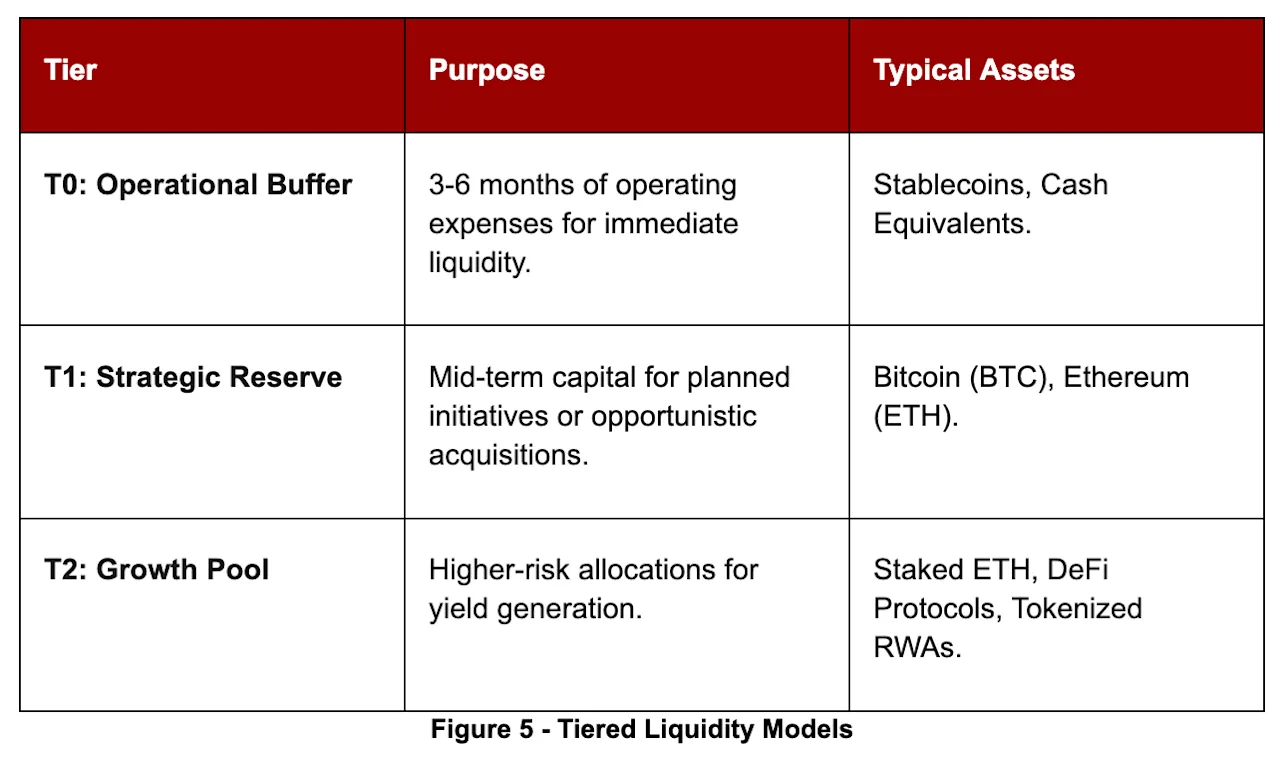
This model ensures that a company can meet its short-term obligations without being forced to sell strategic assets during market downturns, while still allowing for participation in higher-yield opportunities.
A Modern Treasury Technology Stack
A resilient DAT requires an integrated technology stack that automates and secures its operations. Key components include:
- Unified Asset Management: A platform that supports multiple cryptocurrencies in one place, providing a consolidated view of all holdings.
- Automated Compliance: Tools for real-time transaction monitoring to ensure AML and sanctions compliance, including adherence to the FATF Travel Rule.
- Advanced Custody Solutions: A hybrid custody model that combines institutional-grade third-party custodians for strategic reserves with corporate-controlled MPC or multisig wallets for operational funds.
- Integrated Reporting: Dashboards and analytics that provide real-time KPIs on inflows, outflows, and portfolio performance, and which can seamlessly connect to traditional accounting and financial systems.
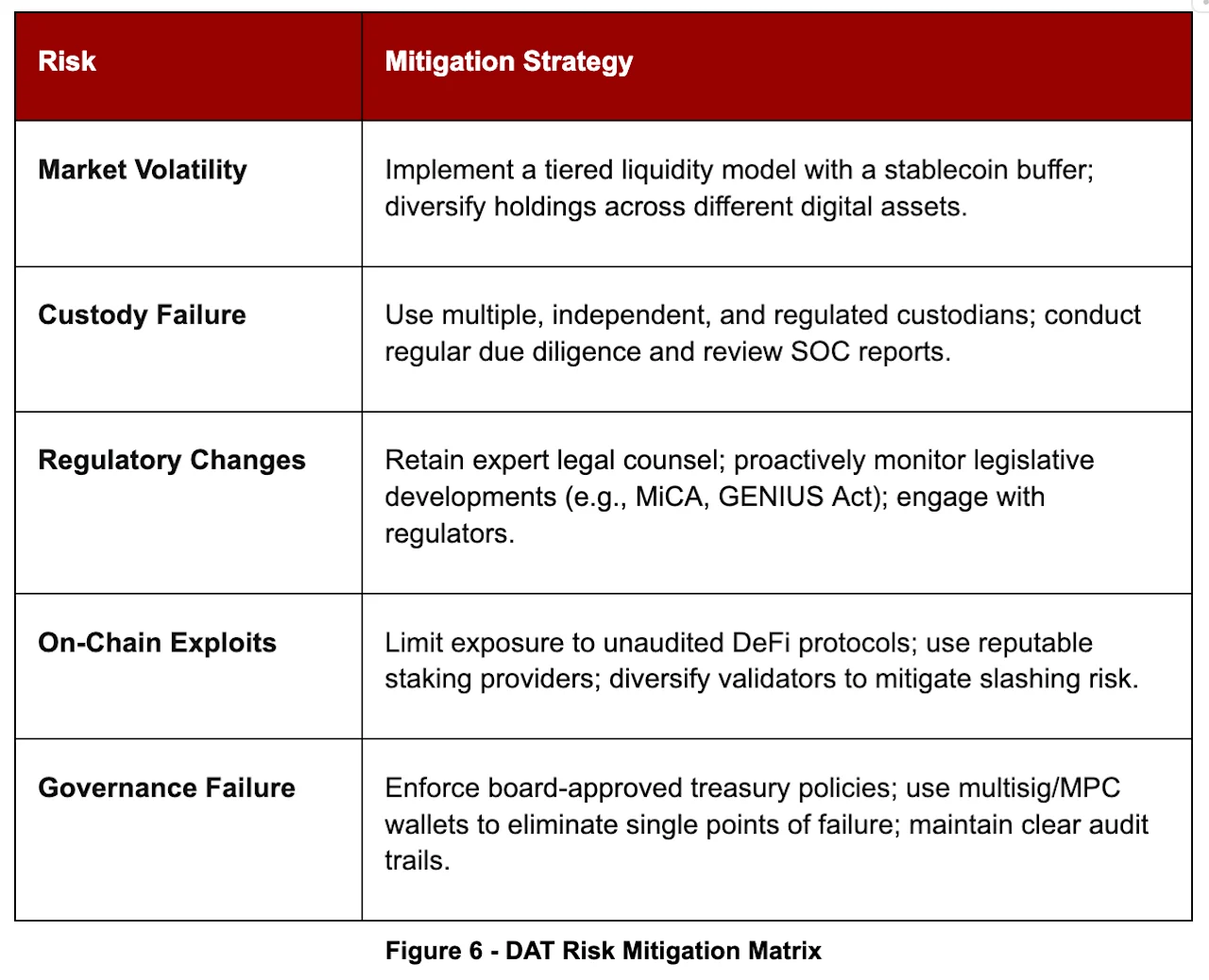
Risk Mitigation Matrix
Future Outlook and Industry Trends
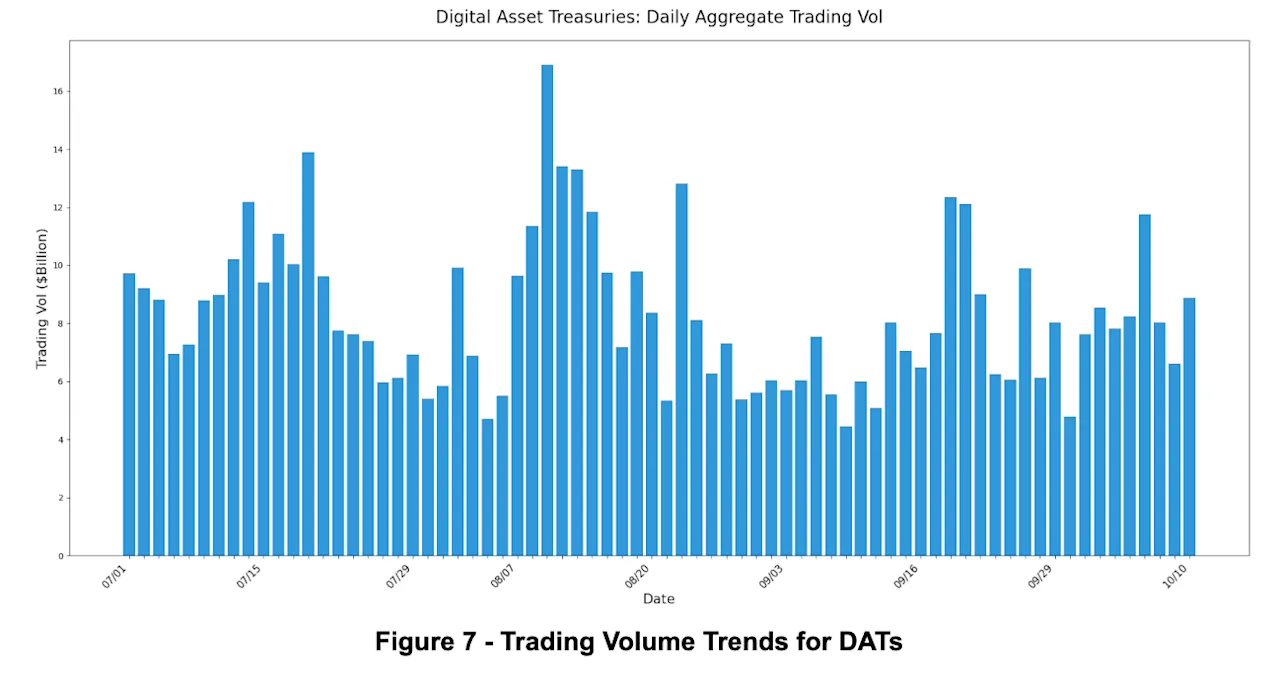
An analysis of DAT issuance and trading volumes shows a steady but minor slowdown in activity as the novelty factor wears off and investors focus on quality, long-term potential. Despite this trend, DATs with long-term viability are expected to maintain a strong presence as the digital assets category continues to grow.
The Rise of AI in DAT Compliance
The U.S. Treasury has signaled a major shift in its approach to AML/CFT, encouraging financial institutions to embrace technology, particularly artificial intelligence. AI is seen as a "force multiplier" that can reduce false positives in transaction monitoring, identify complex illicit networks, and provide more valuable intelligence to law enforcement. For DATs, adopting AI-powered compliance tools will likely transition from a competitive advantage to a regulatory expectation.
The Next Generation of Treasury Assets
The composition of digital asset treasuries is expected to evolve beyond cryptocurrencies. Key trends include:
- Tokenized Real-World Assets (RWAs): As tokenization standards mature, assets like tokenized U.S. Treasury bonds are becoming a viable option for corporate treasuries, offering stable, sovereign-grade yield on-chain.
- CBDC Integration: As central bank digital currencies (CBDCs) are developed, they may become a core component of the operational tier of corporate treasuries, offering new efficiencies for payments and settlement.
The Enduring Correlation Between Security and DAT Quality
A DAT's security and compliance posture will become a major determinant of its long-term market valuation. Research in traditional markets has already demonstrated a strong correlation between robust cybersecurity, compliance, and long-term stock performance viability. In the DAT sector, this dynamic is amplified due to the nature of risk in crypto. As the market becomes more crowded and spot ETFs offer a cheaper form of direct price exposure, investors will increasingly differentiate between DATs based not on what they hold, but how they hold it.
A high Skynet Score, reflecting a multi-custodian strategy, audited internal controls, a resilient capital structure, and transparent disclosures, signals a lower-risk, higher-quality operation. This lower perceived risk will translate directly into a higher and more stable equity premium. In this paradigm, a DAT's investment in a best-in-class security and compliance infrastructure is a direct investment in its own market valuation and a powerful source of sustainable competitive advantage.
Conclusion
The DAT market has transitioned from a novelty trade to an operational discipline. Performance dispersion is now explained less by the notional size of holdings and more by how those holdings are governed. i.e., the quality of regulated custody, the rigor of internal controls, measured on-chain exposure, a resilient capital formation toolkit (ATM capacity over reliance on PIPEs), and a proactive disclosure/compliance posture. Under tightening rules and the normalization of AI-enabled compliance, these attributes define durability and the equity premium a DAT can sustain.
A concise risk note is warranted: capital reflexivity creates structural vulnerability. When shares trade at a premium to NAV, accretive ATMs can compound treasury growth; when a discount emerges, external financing tightens just as underlying token drawdowns pressure book value, amplifying the downside. DATs that pre-position diversified, low-dilution funding options, maintain BTC-centric cold storage with minimal on-chain risk, and keep timely, granular disclosures are best placed to break this feedback loop and preserve long-term optionality.